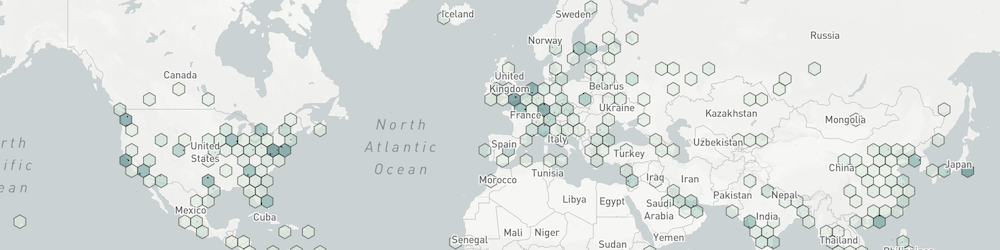


@adaptivelink/pops is a typed ES module for looking up CDN, cloud, and hosting
points of presence by provider or by location. It combines provider inventories
with a normalized location catalog for mapping, coverage comparisons, network
planning, and measurements.
npm install @adaptivelink/pops
# or: pnpm add @adaptivelink/pops
# or: yarn add @adaptivelink/pops
# or: bun add @adaptivelink/pops
The package is ESM-only and has no runtime dependencies.
import PoPs from "@adaptivelink/pops";

// Provider lookup: sorted IATA codes and matching coordinates.
const cloudflare = PoPs.cloudflare;
console.log(cloudflare.code);
console.log(cloudflare.geo);

// code[index] and geo[index] always describe the same location.
const cloudflareLocations = cloudflare.code.map((code, index) => ({
  code,
  geo: cloudflare.geo[index]
}));

// Location lookup: coordinates and every provider mapped to that location.
console.log(PoPs.LIS.geo); // [38.77, -9.13]
console.log(PoPs.LIS.providers);

// Complete internal location catalog.
console.log(PoPs.all.code);
console.log(PoPs.all.geo);
Provider keys are lowercase, such as cloudflare and lightsail. Location
keys are uppercase IATA codes, such as LIS and MAD. An unknown key returns
undefined.
| Lookup | Shape | Description |
|---|---|---|
PoPs[provider] |
{ code: IataCode[], geo: Coordinates[] } |
The provider's unique, sorted location codes and index-aligned coordinates. |
PoPs[iataCode] |
{ geo: Coordinates, providers: ProviderKey[] } |
A location's coordinates and the providers mapped to it. |
PoPs.all |
{ code: IataCode[], geo: Coordinates[] } |
The complete internal location catalog and its index-aligned coordinates. |
Coordinates are decimal-degree tuples in [latitude, longitude] order.
Provider codes without a matching location in the internal IATA catalog are
excluded from the published lookup.
PoPs.all includes known locations that may not currently be referenced by a
provider; check PoPs[code]?.providers.length when that distinction matters.
TypeScript declarations and the public types are included:
import PoPs, {
  type Coordinates,
  type IataCode,
  type LocationPoPsEntry,
  type ProviderKey,
  type ProviderPoPsEntry
} from "@adaptivelink/pops";
Use IataCode and ProviderKey when indexing with dynamic values. The
declarations intentionally reject arbitrary strings because unknown runtime
keys return undefined.
Provider names and source URLs are dataset metadata and are not part of the published object. The default export contains only provider, location, and aggregate lookup entries.
| Provider | Key | Provider | Key |
|---|---|---|---|
| Adaptive Link | adaptive |
Alibaba Cloud | alibaba |
| Aruba Cloud | arubacloud |
Atlantic.Net | atlanticnet |
| Azure CDN | azurecdn |
Azure VM | azurevm |
| Backblaze | backblaze |
BunnyCDN | bunnycdn |
| CacheFly | cachefly |
CDN77 | cdn77 |
| Cloudflare | cloudflare |
AWS CloudFront | cloudfront |
| CloudSigma | cloudsigma |
Deno Deploy | deno |
| DigitalOcean | digitalocean |
Equinix | equinix |
| AWS EC2 | ec2 |
Fastly | fastly |
| Flexential | flexential |
G-Core Labs | gcore |
| Google Cloud CDN | googlecdn |
Google Compute Engine | googlecompute |
| Heroku | heroku |
Hetzner Cloud | hetzner |
| Hivelocity | hivelocity |
Hostwinds | hostwinds |
| Imperva | imperva |
Ionos Cloud Servers | ionos |
| Kamatera Express | kamatera |
KeyCDN | keycdn |
| LeapSwitch | leapswitch |
AWS Lightsail | lightsail |
| Limelight Networks | limelight |
Linode | linode |
| MNX.io | mnx |
Netlify | netlify |
| OVH | ovh |
Packet | packet |
| Scaleway | scaleway |
StackPath | stackpath |
| Sucuri | sucuri |
UpCloud | upcloud |
| Verizon Media | verizonmedia |
Vercel | vercel |
| Vultr | vultr |
Wasabi | wasabi |
Provider locations are normalized to the repository's IATA convention. The coordinates represent those airport or metro locations; they are not exact facility addresses, proof of real-time availability, or latency measurements.
Provider networks change. If a location is missing or inaccurate, use the inaccurate data issue template. Requests for additional networks can use the new provider template.
Selected provider inventories have source and normalization instructions in
tools/providers/catalog.js. The maintenance
workflow is documented in
tools/providers/README.md.
Contributor tooling uses Bun. Tests load the generated
dist/bundle.js, so build before running them:
bun install
bun run build
bun run test
Run bun run prebuild before committing JavaScript or JSON changes; it formats
those files and regenerates main.d.ts. For data changes, bun run validate
reports provider codes that do not exist in the internal location catalog. Do
not edit dist/ by hand.
For agent-assisted provider maintenance:
bun run providers:list
bun run provider:show vultr
bun run provider:maintain vultr
See RUNS.md for recorded provider review dates. All contributions are released under the project's MIT license.
The notebooks/ directory contains an exploratory coverage
simulation, also available as a
Kaggle notebook.