









Curriculum Vitae · English · Lebenslauf · Deutsch


 |
 |
 |
 |
 |
 |
 |
 |
 |
 |
 |
 |
The map shows protocol interfaces, libraries, tools, and assets. Applications select the components they need.
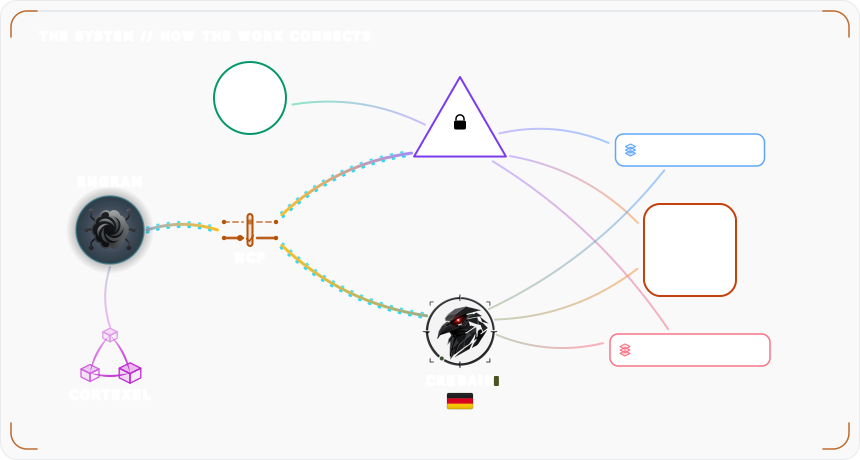
Open diagram · zoom and explore · Original SVG: light · dark
Read the connections: solid paired arrows = local NCP interfaces; short dashed arrows = library dependencies; long dashed open arrow = environment and sensor integration, with the sensor path tested; dotted lines = assets or exports; moving dashes on a continuous line = perception tools; dash-dot line with a square end = Haldir's pinned NCP v0.8 interface.
Different jobs: Engram runs neural models. CREBAIN runs a standalone 3D environment and sensor fusion. Galadriel optionally checks sensors for possible tampering. Prisoma organizes experiments and evidence for embodied agents. NCP defines their shared messages.
Tested neural loop: Engram ran a real NEST network through NCP with CREBAIN. The loop ran 8 neural steps and 24 body ticks. All 64 readouts matched direct NEST execution. The test used explicit network and scene inputs. Paper-derived model reproduction remains a separate task.
CREBAIN and Prisoma: Prisoma records commands before CREBAIN executes them. Installed body-only and canonical runs matched all 44 payloads, totaling 4,326,400 bytes. A 192-run timing study missed every 120-Hz deadline. The native pressure study completed 112 episodes with restored labels. Forecast improvement missed the declared useful threshold.
Four-owner local v1 reference. Local sensor and neural loops passed their declared checks. Broader qualification and final v1 release gates remain open.
The tested Engram implementation is private Paper2Brain source. The public Engram repository is a placeholder, not an executable release. Read the NCP release status.
Components, sensors, and operating limits
CREBAIN runs standalone. Applications can add Engram neural models, Prisoma recording, or Galadriel monitoring. One endpoint can expose several identified sensors.
Each camera and microphone retains its identity and timing. Prisoma defines features, source groups, targets, and statistical assumptions. PID-rs estimates the declared quantities. The initial PID study selects two through four source variables; NCP imposes no such limit.
Melkor converts splat assets. The atlas projects provide mesh assets. These are intended CREBAIN inputs; the full import path remains unqualified.
The four-owner reference routes CREBAIN observations to Engram and returns its action proposals. Galadriel records diagnostics, and Prisoma captures complete exchanges. Applications can select smaller compositions through the modular interface.
Engram coordinates one local experiment and privately owns neural state. CREBAIN owns body and fusion state. Prisoma captures exact step pairs. Galadriel records actual detector output with explicit abstention.
Each owner exchanges bounded requests and results through its own private process channel. NCP defines the shared contract.
Galadriel's current detector requires two sensor modalities. Two RGB cameras supply one Visual modality. Missing evidence produces abstention, never a nominal report.
Supported boundary: This candidate targets local Darwin simulation. Haldir gating, remote endpoints, physical actuation, and real-time guarantees are excluded. Gated requests must be rejected before endpoint preparation. Capture and monitor results grant no command authority.
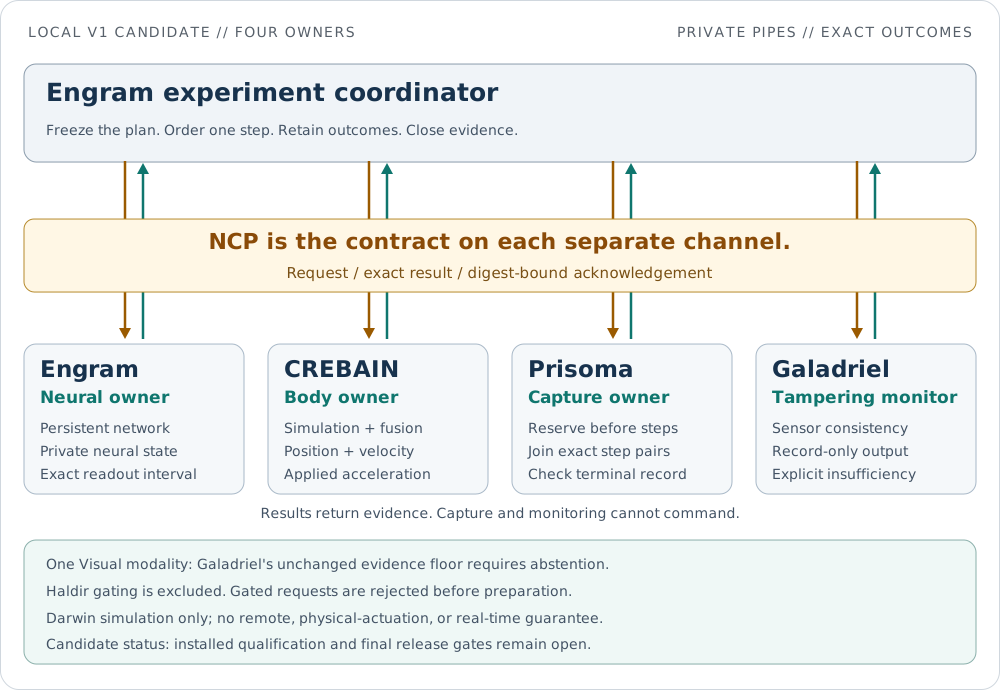
Open diagram · zoom and explore · Original SVG: light · dark

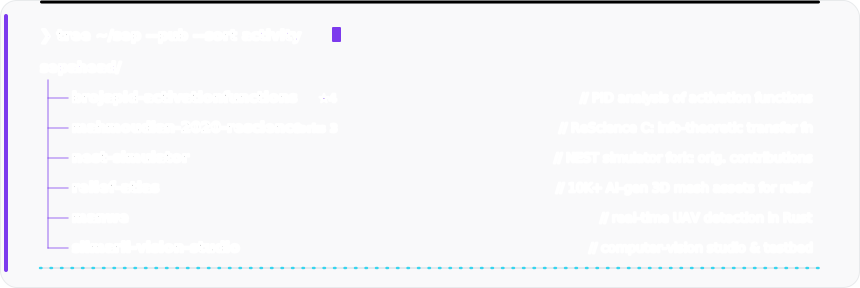
↗ brojapid-activationfunctions · mahmoudian-2020-rescience · nest-simulator · relief-atlas · silmaril-vision-studio







|
 





|
 



|
 





|